Standards
1-3: Setting Up for Success
4-6: Core Treatments
7-9: Rounding out the OA Journey
CLINICIAN STANDARDS
Standard 4. Core Treatment 1: Education
Osteoarthritis (OA) education programs should be offered to all people diagnosed with OA of the hip or knee. Understanding OA empowers the individual with the knowledge and tools to self-manage their symptoms and enjoy life as much as possible. Accessible education resources can be provided in various formats, including in-person group education programs, community-based programs, virtual platforms and written materials.
Overview
Key Messages for Osteoarthritis Education
- Should be offered to all individuals diagnosed with OA, and continued to be offered throughout their lifetime.
- Empowers and equips the individual with the knowledge and tools to self-manage their condition and health outcomes.
- May offer broad introductory information such as an introduction to OA class or introduction to nutrition class.
- May be offered to understand a specific treatment, such as about how a pool exercise program is going to work, the GLA:D™ education classes, or classes on self-management coping strategies.
Introduction
Education should be offered to all individuals diagnosed with osteoarthritis (OA), and continued to be offered throughout their lifetime to address their knowledge gaps. Education empowers and equips the individual with OA with the knowledge and tools to self-manage their condition and health outcomes. Selecting new education options with each revision of a care plan will allow for:
- Basic information about OA to be regularly refreshed
- Emerging evidence for OA to be translated in a reasonable time frame to the individual
- Opportunities to build community with others living with OA and
- A chance to inspire selection and revisiting of treatment options and self-management strategies, particularly for symptom management options including:
- Thermotherapy (Standard 7) and
- Activity self-selection (Standard 5)
At all follow-up visits, reassess the individual’s symptoms and function and offer additional education resources that will support the individual’s current needs and goals. Information they are directed to should address the individual’s needs, goals, preferences and values while also incorporating health change principles.
OA Education Classes
There are two types of education classes relevant to individuals with OA:
- Education classes that provide broad, possibly introductory, information about a topic:
- i.e. An introduction to OA class.
- i.e. An introduction to nutrition and OA class.
- Education classes that are specific to understanding a treatment:
- i.e. Education about how a pool exercise program will affect their joints and how to adapt exercises for their needs.
- i.e. Good Life with osteoarthritis: Denmark (GLA:D) education sessions.
- i.e. Self-management coping strategy classes.
Designing OA Education
Education sessions can be delivered in verbal, written and/or virtual formats.
The OA Self Management Education Booklet aligns with the topics for an introduction to OA education and can be provided to the individual with OA as early as first confirmation of diagnosis. There is also an accompanying Powerpoint presentation for the booklet. Examples of publicly available materials are provided in the Health Resources Matrix.
Look for community organizations as well as health organizations to find applicable educational programs. For instance, a recreation centre may have an OA focused class. Build relationships with local educational programs and keep a Resource Inventory up to date with the program schedule for these classes and to ensure individuals with OA are directed to the program that is most applicable to their gaps in knowledge.
If there are no local education programs running in the area, consider running one. Consider using group teaching to build a community for individuals with OA to connect with one another. Locally developed materials should align with these standards, the OA Treatments and best evidence. Successful education material should be presented in ‘patient friendly’ language and offer opportunities for interaction and question answering. Consider partnering with other agencies or programs as well to deliver a multi-disciplinary approach.
OA Self Management Toolkit
OA Self Management Toolkit (PDF)
The Toolkit includes the supporting tools :
Alberta Referral Directory
Alberta Referral Directory to assist with:
- Identifying diagnostic imaging locations
- Orthopaedic surgery referral requirements to the Alberta Hip and Knee Program (if appropriate)
- Designing a local Resource Inventory and keeping it up to date
- Referral to other clinicians
Introductory Education Class on Osteoarthritis
An introduction to Osteoarthritis (OA) class should include the following topics:
- Overview of OA: Causes, symptoms and prognosis
- Self-management strategies:
- Daily symptom management through: Application of thermotherapies; and Activity self-selection.
- Healthy behaviours and lifestyle modifications: Nutrition; and Physical activity.
- Core Treatments and Adjunct Treatments and the strength of evidence available for each
- Importance of each Core Treatment: education, exercise and physical activity, and weight management
- Safe movements for joints;
- Benefits and risks of Pharmacological and Non-Pharmacological treatments;
- Safe use of walking aids and assistive devices;
- The role of the Primary Clinician and how supporting clinicians will have different expertise to support other treatments;
- The importance of making a care plan with specific goals and updating that care plan as symptoms and life evolve; and
- Tracking symptoms and treatment trials.
Self-Management
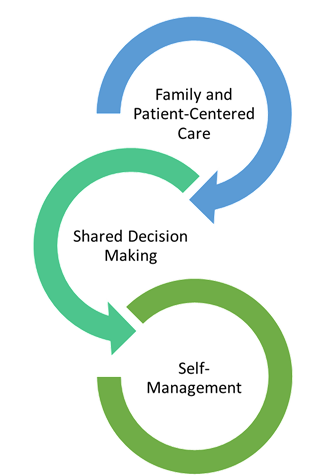
Osteoarthritis (OA) is a progressive disease with no cure. Osteoarthritis Research Society International (OARSI) and Patient and Community Engagement Research (PaCER) findings have concluded that the individual needs to have control of their care journey. The individual lives with their evolving disease every day, while the clinicians only provide support for short periods of time or short interactions1313Not available.. Throughout these nine standards, the principles of self-management are reinforced. Confidence in self-management can be supported by employing ‘family and patient-centred care’ principles using shared decision-making techniques.
All the processes and strategies described in these standards focus on empowering the individual to gain knowledge and to make choices for their OA journey based on that expanding knowledge. The principles of self-management are crucial to day-to-day symptom management. Symptoms of OA can flare up without explanation and the empowered, engaged and educated individual will be able to take action when this occurs.
As care progresses, every clinician should support the individual to gain confidence in applying their expanding OA knowledge to make treatment and self-management choices. Self-management strategies for OA include:
- Priority and goal setting
- Self-evaluation
- Problem-solving
- Mental health management
- Symptom management:
- Thermotherapies
- Activity self-selection
- Seeking clinician appointments as needed
More detail is provided in Standard 7 for those individuals who want to build more confidence in self-management techniques.